
Australian Objectivists - Get Up From Your Armchairs!

Australian Objectivism's strategic reserve, pictured here remaining strategically in reserve.
“An idea unexpressed in physical action is [a] contemptible hypocrisy.” — Francisco d’Anconia, Atlas Shrugged
There is a peculiar kind of Objectivist I have encountered rather often in Australia.
He knows what the Ayn Rand Institute is doing wrong. He knows what Yaron Brook should say differently. He knows which speakers should be invited, which events should be held, how an Objectivist organisation should be structured, and what those of us running one ought to do next.
There is only one conspicuous omission from his program.
Himself.
I exaggerate, but not by much.
Since founding the Australian Centre for Objectivism, I have received plenty of advice from Australian Objectivists. Some of it has been excellent. I want criticism. My team can attest that if somebody gives me a better argument than the one I currently accept, I change my mind and act accordingly.
Criticism is indispensable.
What I object to is criticism as a substitute for action: the curious habit of treating one's ability to identify flaws in other people's work as though it were itself a form of origination.
It isn't.
My response is simple:
Go and do something.
I'm not arguing for activism. I am arguing for integrity.
If you profess Objectivism as the true philosophy and then systematically decline to express its principles in action, there is a problem with calling yourself an Objectivist. A philosophy is not a set of propositions to which you privately assent. It is a guide to living.
This applies to values generally.
The evidence that something is a value is not that you say you value it. It is that you act to gain or keep it.
Suppose a man tells you that physical fitness is one of his highest values. He does not exercise. He eats terribly. He has no intention of changing either fact. How seriously should we take the claim?
Or suppose someone announces that building a business is his consuming ambition. Five years later he has produced several notebooks of plans, an impressive collection of podcasts about entrepreneurship, and no business.
At some point we stop calling this an unrealised value and start calling it a preference for thinking about one.
The same standard applies here.
If you believe that Objectivism is true; that reason, individualism and capitalism are vital to human flourishing; and that the surrounding culture is increasingly hostile to those principles, yet this conviction produces no action whatsoever over decades, then what exactly does it mean to say that these things are values to you?
The qualification matters: act on whichever scale is appropriate to your hierarchy of values, circumstances and capacities.
Nobody has a duty to become a professional activist. One person might rationally devote a career to intellectual work. Another might write a cheque. Another might bring a friend to an event twice a year. Another might build a successful business and defend capitalism when the subject arises.
Integrity requires no break between between thought and action.
Nor can this problem be escaped by saying that you “privately practise Objectivism.”
There is a strange assumption buried in that phrase: that society is something happening outside your house.
It isn't.
You live under political institutions. You work in markets shaped by laws and cultural attitudes. Your children are educated in schools and universities. The people you employ, marry, trade with and vote alongside absorb ideas from the surrounding culture. Cultural attitudes determine which institutions are built, which laws become politically possible, which entrepreneurs are admired or condemned, and which ideas the next generation encounters.
You may decide that changing these things ranks relatively low in your personal hierarchy of values. Fair enough.
You cannot decide that they have nothing to do with your life.
Culture is part of the environment in which you pursue your values. If you like it, you have an interest in maintaining it.
And if you don't like it, change it.
That is the point of Francisco's condemnation of “an idea unexpressed in physical action.” Integrity rejects a split between mind and body: one set of principles in your head, another set of forces determining what you actually do.
If an alleged conviction leaves no trace in your conduct, indefinitely, one should eventually reconsider whether “conviction” is the right word.
Why bother?
The armchair position usually rests on some combination of three arguments.
First: nothing can be done.
Australians are hardly crying out for Objectivism. Our political parties compete over different varieties of government-initiated force. Our universities are not exactly hotbeds of individualism. Objectivists are a tiny minority.
The conclusion is familiar: the culture is hopeless, so why waste your time?
Notice the assumption. Because success is difficult, success is impossible.
Success is usually difficult. And every great advancement of mankind was originated by some individual who dared to attempt what others dismissed as "impossible".
Second: one person cannot make a difference.
This sounds plausible largely because people imagine cultural influence as though it were democratically distributed: eight billion people, eight billion approximately equal droplets in an enormous ocean.
History is not remotely like this.
Cultural influence is radically unequal. Most people leave almost no intellectual footprint. A handful alter the direction of entire cultures.
Ayn Rand was one woman.
She arrived in America as a young immigrant from Soviet Russia, wrote novels and philosophical works, developed a new philosophy, and created an intellectual movement that continues half a century after her death. Her ideas have reached businessmen, academics, students, politicians and artists around the world.
Eventually they reached me in Australia.
“I am only one person” therefore tells us remarkably little.
Of course, you probably aren't Ayn Rand.
Neither am I.
Fortunately, the available choices are not limited to found a new philosophy and sit at home.
Some people are drops in the ocean.
Some are currents.
And you generally discover which is which by acting, not by estimating your historical importance in advance.
I discovered Objectivism largely through Yaron Brook. His decision to spend his career communicating these ideas eventually reached a young Australian on the other side of the planet. That Australian later founded an Objectivist organisation of his own. Now that organisation is about to bring Objectivism to a national audience.
Yaron could not have predicted that causal chain.
That is how cultural influence often works. One person reaches ten. One of the ten does something unusually consequential. Effects compound.
The armchair calculation quietly assumes that we know the downstream consequences of our actions before taking them.
We don't.
The third argument is much better: I have better things to do.
Quite possibly, but context is everything here.
You have a career to build, money to make, relationships to enjoy, businesses to run, children to raise and books to read. Objectivism does not demand that everyone become a professional activist. Your life is your highest value—not “the movement.”
If spending another hour on your business is more valuable than spending it promoting Objectivism, spend it on your business. But where is getting involved in your hierarchy within the context of leisure time (i.e. time explicitly "protected" from your professional and family commitments)?
But notice another false choice.
The alternatives are not twenty hours a week of activism or zero.
You can bring a friend to an event. Introduce two people. Donate money. Write something. Volunteer once. Recommend a book. Defend capitalism in a conversation in which you would otherwise remain silent.
The relevant question is not:
Why aren't you sacrificing more?
It is:
If you regard these ideas as profoundly important, why does that conviction so produce no observable behaviour whatsoever?
That is a question about integrity.
The armchair critic
This becomes particularly noticeable when passivity is combined with prolific criticism of people who are actually doing the work.
I am currently trying to bring Yaron Brook back to Australia, including to Sydney. In discussing this, I discovered that some Sydney Objectivists apparently remain intensely critical of him over disagreements dating back to his visit in the 1990s.
The 1990s.
Perhaps their criticisms are correct. Perhaps not. I wasn't there. Yaron is fallible, and when I interviewed him he specifically emphasised the importance of accepting criticism.
But there is an interesting asymmetry here.
For decades, Yaron has travelled the world defending capitalism and individualism, often before hostile audiences. He has written books, debated opponents, led ARI, delivered thousands of talks and interviews, raised millions for Objectivist causes, built institutions and introduced an enormous number of people - including me - to Rand's ideas.
One can certainly criticise mistakes.
But if one man's ledger contains several decades of action plus some mistakes, while yours contains a detailed catalogue of his mistakes, I would hesitate before declaring victory.
The same phenomenon surrounds ARI and other Objectivist organisations. I have criticisms of them too.
But they have one considerable advantage over the permanent spectator:
They actually do something.
Action collides with reality.
Organise an event and you discover that speakers have schedules, venues cost money, audiences sometimes fail to appear, advertisements underperform, volunteers forget things, and the perfect plan developed over coffee has the irritating defect of requiring actual human beings to execute it.
Try persuading people and you discover that the argument which seems conclusive after twenty years of reading Objectivist literature may mean absolutely nothing to someone encountering the ideas for the first time.
Build an organisation and you discover opportunity costs, limited resources, conflicting priorities and trade-offs.
The armchair has very favourable operating conditions. No budget. No deadlines. No customers. No staff. No risk of failure.
It is astonishing how few mistakes one makes there.
None of this means the practitioner is right and the spectator is wrong. Truth does not depend upon a résumé. An unemployed twenty-year-old can identify an error made by a CEO.
But the armchair perspective often smuggles in another false assumption: that identifying an imperfection establishes that the critic's preferred alternative would have worked better.
It does not.
Every real course of action must be compared with another possible course of action under the same constraints—not with an imaginary alternative possessing unlimited money, perfect information, flawless personnel and the benefit of hindsight.
That distinction eliminates a remarkable amount of criticism.
If you can do better, do better
There is a simple cure for this problem.
Think ARI's strategy is wrong?
Develop a better one.
Think ACO runs the wrong events?
Run the right ones.
Think our writing is ineffective?
Write something better and see whether anyone reads it.
Think Australian Objectivists need an institution that does not exist?
Build it.
This has the useful property of converting opinions into evidence.
You might succeed. Excellent.
You might fail. You'll learn something.
Perhaps your criticism will be vindicated. Perhaps you will discover that the idiots you were criticising had reasons for behaving as they did. Perhaps you will discover a third approach better than either.
Reality is an exceptionally good referee, although regrettably insensitive to how convincing your theory sounded in the living room.
And there is a moral difference here too.
The person who acts assumes responsibility for consequences. He risks time, money, reputation and failure. He discovers whether his convictions survive contact with reality.
The permanent spectator risks being wrong in conversation.
These are not equivalent positions.
"Fine. What can I actually do?"
There was, until recently, a more legitimate objection.
Suppose an Australian Objectivist wanted to contribute. To what?
Australia is enormous. Our Objectivist community is small and dispersed. Most people have neither the time nor the desire to establish an organisation, build a mailing list, recruit a team, find speakers, negotiate with venues and invent projects from scratch.
Fair enough.
That is one of the reasons ACO exists.
We are building infrastructure through which Australian Objectivists can combine their efforts.
You do not need to start another organisation. You do not need to create your own mailing list or spend six months finding a project.
We have projects.
Our Australian premiere of We the Living is one of them.
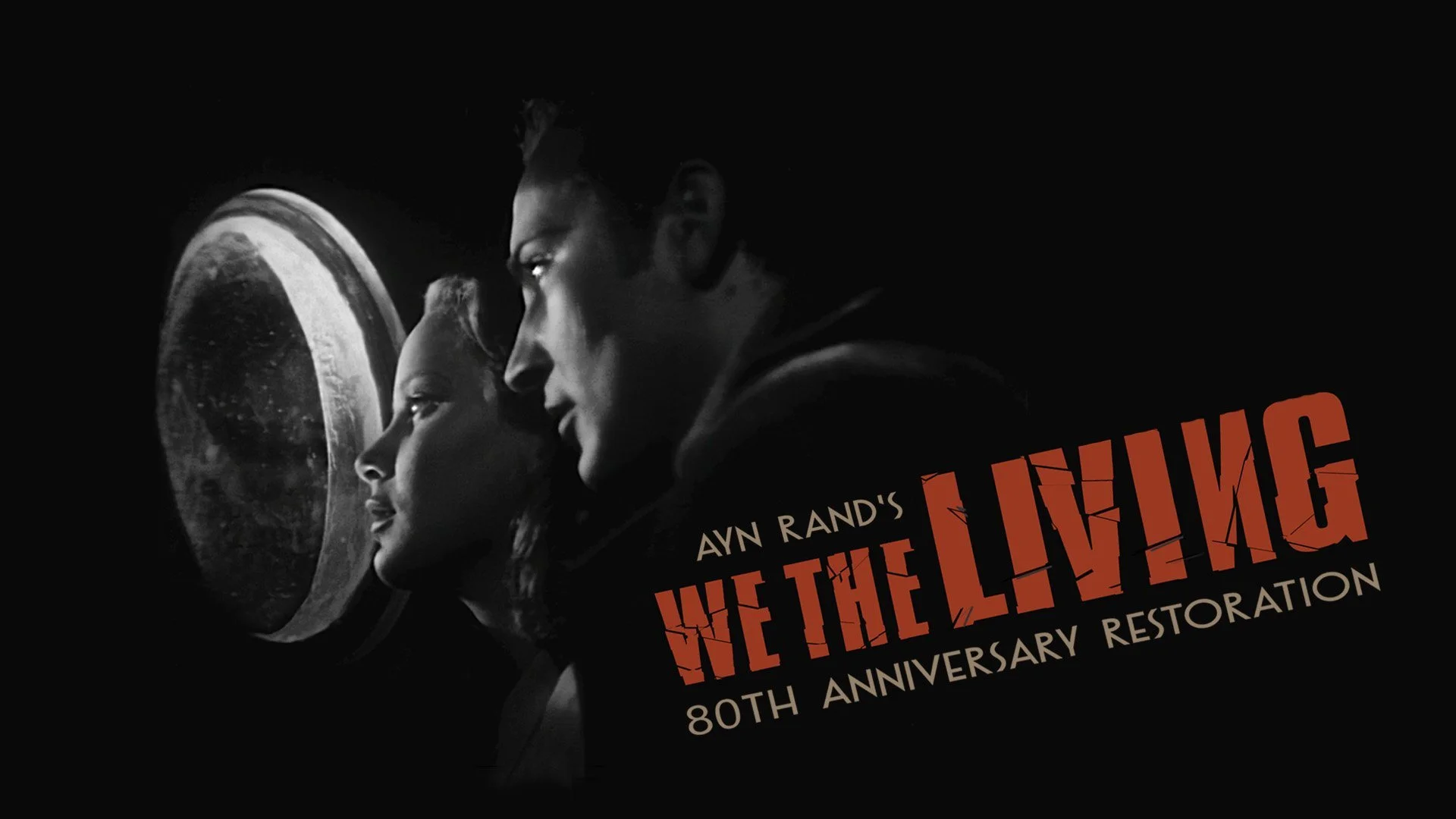
We the Living will be premiering in Australian cinemas very soon.
We have the opportunity to bring the restored film to Australia, hold a major premiere, introduce new audiences to Rand's work, bring Objectivists together, and use the premiere as the foundation for screenings elsewhere in Australia.
This is exactly the sort of thing everyone agrees would be wonderful right up until the moment somebody has to make it happen.
Unfortunately, cinemas remain stubbornly unwilling to book themselves.
Money has to be raised. Audiences found. Organisations contacted. Promotional material produced. Tickets sold. Problems solved.
Ideas require embodiment.
So if you want to contribute, there are three obvious ways.
1. Fund us
This is the best option for people with more money than time.
Events, speakers, advertising and films require resources. Money allows people with time and ability to execute projects that would otherwise remain attractive ideas.
The We the Living premiere is an immediate opportunity. We have already raised over 6k of 10k. If you belong in this category, help us raise the other 4k. It'll take you one minute, and you have my gratitude.
2. Join the team
This is the option for people who want continuing responsibility.
We need far more than Objectivist intellectuals. In fact, unless you are producing intellectual content, knowing the finer points of Objectivist epistemology is considerably less useful than knowing how to edit a video properly.
We need people who can write, design, market, organise, photograph, edit, fundraise, research, develop partnerships, manage technology and solve problems.
If you can do something useful, there is probably something useful for you to do. Reach out to me directly. maxim.bishev@objectivism.au
3. Volunteer when needed
This is the option for people who cannot make an ongoing commitment.
Help at one event. Make one introduction. Contact ten organisations. Photograph something. Sell tickets. Give us an afternoon.
You do not have to reorganise your life around ACO.
You merely have to occasionally leave the armchair.
Integrity requires consequences
None of this means every Objectivist must become an activist.
It means something more basic.
If you believe that reason matters, that individual rights matter, that capitalism matters, that the culture in which you live matters - and that Objectivism offers ideas of indispensable importance to human life - then those convictions should have some causal relationship to what you actually do.
The armchair position survives by accumulating false alternatives:
Either I transform the culture or my contribution is worthless.
Either I devote my life to activism or I should do nothing.
Either an organisation acts perfectly or its mistakes discredit its work.
Either I can predict the consequences of my contribution or there is no reason to make one.
Either I can personally execute an entire project or there is nothing useful for me to contribute.
None of these propositions is true.
And we have now removed another excuse: the absence of an organised mechanism for action.
ACO exists. Projects exist. The We the Living premiere exists. There is work to do.
Francisco's phrase is deliberately severe: “an idea unexpressed in physical action” is contemptible hypocrisy.
Quite right.
Objectivism was not developed so that a small collection of Australians could privately agree with it very intensely.
Fund something. Build something. Volunteer for something. Persuade someone.
But do something.
Australian Objectivists: get up from your armchairs.