
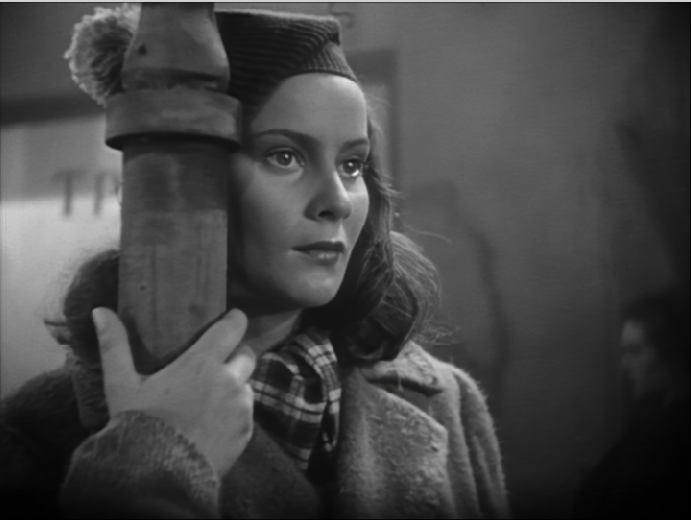
Alida Valli as Kira Argounova in the Italian We the Living (1942), based on Ayn Rand’s novel.
Most novels about totalitarianism focus on prisons, secret police and executions. We the Living is different. Ayn Rand's first novel is concerned with something quieter and, perhaps, more frightening: the gradual destruction of the individual. Rand's question is not, How does a dictatorship kill people? It is, How does it make life impossible to live? What happens to ambition when achievement is punished? What happens to integrity when survival demands compromise? Rather than answering these questions abstractly, Rand conducts three experiments through her central characters.
Kira Argounova represents the independent individual. She wants to study engineering, pursue the man she loves, and build a life through her own ability. Under dictatorship, however, even these private ambitions become political offences. The state rarely destroys her through dramatic violence. Instead, it removes opportunities one by one; education, work, independence, until dependence becomes almost unavoidable. Rand's point is profound: the greatest weapon of dictatorship is often attrition of both material and spiritual values.
Leo Kovalensky illustrates a different consequence. Some people are not physically destroyed by tyranny; they are spiritually exhausted by it. As opportunities disappear and effort seems increasingly futile, the temptation to stop caring rises. Rand distinguishes survival from living. A person may continue breathing while slowly abandoning the values that once made life worth pursuing.
Andrei Taganov explores perhaps the most surprising question of all: What happens to an intelligent, sincere believer? Rand refuses to portray every Communist as a cynical villain. Andrei genuinely wants justice. His tragedy lies in discovering that reality refuses to conform to the ideals he serves. Through him, Rand argues that dictatorship ultimately destroys not only its opponents, but its most principled supporters.
Leonard Peikoff summarised the novel's philosophical significance in Objectivism: The Philosophy of Ayn Rand:
[Under a dictatorship] citizens' own understanding of reality, along with their own value-judgments, is irrelevant to their lives; state force, not individual cognition, is the principle governing their actions. To the extent that an individual is moral, therefore—i.e., is rational, independent, uncompromising, purposeful, proud—his life becomes unendurable. Such an individual has only three alternatives, which are defined in Ayn Rand's We the Living. He may attempt to flee the country, as Kira did. He may kill himself, as Andrei did. Or he may try to make the conflict between force and mind endurable, as Leo did, by nullifying one of the two clashing elements, the only one within his power.
The reason dictatorship produces these outcomes, Rand argues, is that force attacks the very faculty by which human beings live: their rational judgment. In Capitalism: The Unknown Ideal, she writes:
... an attempt to achieve the good by physical force is a monstrous contradiction which negates morality at its root by destroying a man's capacity to recognize the good, i.e., his capacity to value. Force invalidates and paralyzes a man's judgment, demanding that he act against it, thus rendering him morally impotent... An attempt to achieve the good by force is like an attempt to provide a man with a picture gallery at the price of cutting out his eyes.
While the novel is centred on the tyranny of Soviet Russia, We the Living is about the effects of dictatorship, particularly on the best among men and women. Rand shows, step by step, how a political system built on force severs the connection between thought and action. When achievement is punished, honesty penalised, and independence made impossible, tyranny no longer needs to crush the individual outright. It is enough to make virtue impossible to practice, which means: to "forbid life to the living".
